
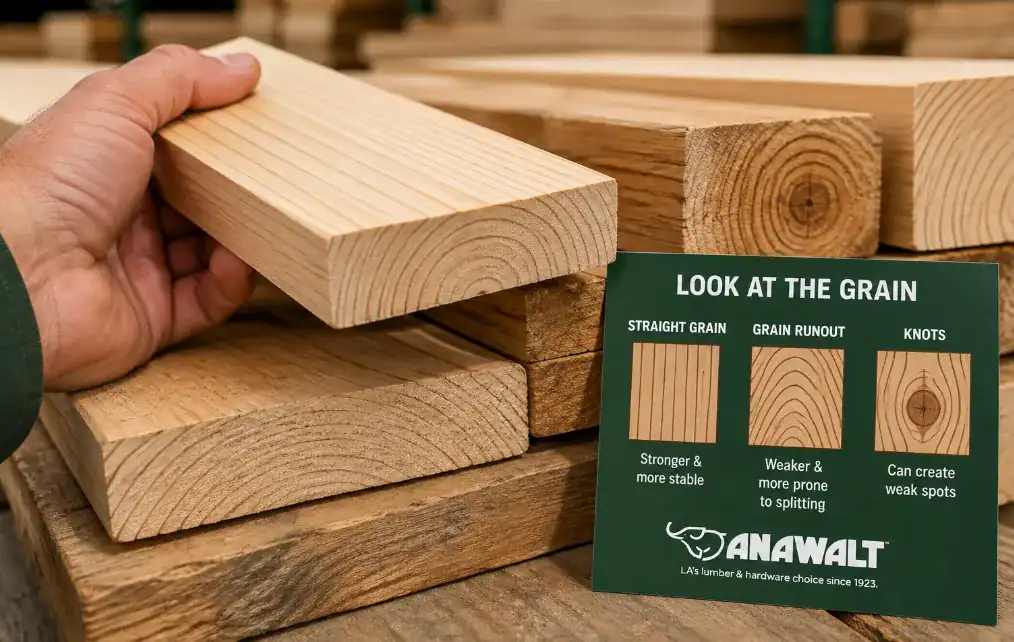
Picking lumber can seem pretty simple at first. You find the size you need, check the price, and make sure the board does not have a giant crack running through it.
But there is another thing worth looking at.
The grain.
Wood grain direction can tell you quite a bit about how a board may behave after you cut it, fasten it, or bring it into a different environment. Grain can affect strength, appearance, movement, and even whether a board is likely to stay reasonably straight.
That does not mean you need to become a wood expert before buying a few boards. You really do not. But learning what to look for can make lumber selection a little less like guessing.
At Anawalt Lumber, customers choose lumber for everything from repairs and framing to furniture, outdoor projects, and finish work. The “best” board is not always the prettiest one in the stack. Sometimes it is the board that is simply better suited for what you are building.
Start by Looking at the Long Grain
If you are wondering how to read wood grain, start with the face and edge of the board.
Look at the lines running along the wood.
On some boards, those lines look fairly straight from one end to the other. On others, they curve around knots, wander toward an edge, or disappear out of the face.
This wood grain direction gives you clues about how the fibers run through the board.
Straight-grain lumber is often easier to work with because the fibers generally follow the length of the board. It can cut more predictably, and for certain projects, it may provide better strength along its length.
But perfectly straight grain is not required for everything.
A decorative board with interesting grain can look great in furniture or trim. A framing board has a different job. What matters depends on where the lumber is going.
That is probably the biggest thing to remember when choosing wood. There is no single perfect board for every project.
Why Grain Direction Can Affect Strength
Wood gets much of its strength from long fibers running through it.
Imagine a bundle of drinking straws held together. If the straws all run in the same direction, the bundle behaves differently than if some of them suddenly angle off toward the side.
Wood is obviously more complicated, but it is a useful way to picture it.
When wood grain direction runs fairly straight along a board, the fibers can continue through more of its length.
Grain runout in lumber happens when those fibers leave the board’s surface or edge rather than continuing straight through it.
You may also hear people talk about the slope of grain. A steep grain slope can matter in pieces that need to carry loads because the fibers are not running directly along the board.
This helps explain how wood grain affects strength.
A board can look solid and still have grain patterns that make one section less predictable than another.
Knots can change the grain too. The fibers have to grow around the branch, so they bend and twist around that area.
Again, that does not make every knot bad. It just means you should think about where it will end up in the finished project.
Look at the End of the Board Too
Most people inspect the wide face of a board.
Then they stop.
The end grain can tell you something different.
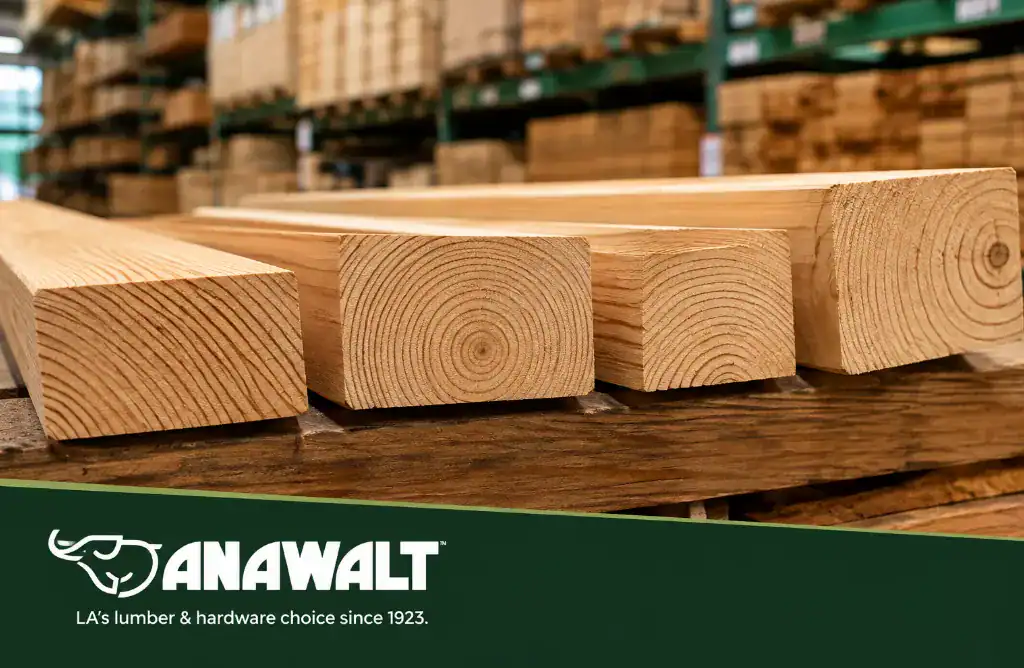
Look at the growth rings on the end of the board. Their shape and angle can give you an idea of how that board was cut from the log.
End grain direction and growth ring orientation can help explain why two boards from the same type of tree may behave differently.
Some boards show growth rings that run more or less across the width. Others show rings standing at a steeper angle.
This is where the difference between flat-sawn vs quarter-sawn lumber starts to matter.
Flat-sawn lumber is very common and usually shows wider, more noticeable grain patterns on the face. Quarter-sawn lumber is cut so the growth rings meet the face at a steeper angle.
Quarter-sawn boards may offer better stability in certain directions, though they can cost more and may not be needed for an ordinary project.
Still, checking the end of a board takes about two seconds.
It is worth doing.
Wood Moves Even After It Becomes Lumber
Wood may be cut into boards, but it still reacts to moisture.
This surprises people sometimes.
A board can absorb moisture when the surrounding air becomes humid and lose moisture when conditions become dry.
As that happens, the wood can expand and shrink.
And it does not move equally in every direction.
Understanding wood grain direction helps because most wood movement happens across the grain rather than along the board’s length.
This is called wood movement across the grain.
There are also differences between radial and tangential wood movement. In simple terms, wood tends to move differently depending on whether the movement follows the direction of the growth rings or crosses them.
You do not need to calculate all of this every time you buy lumber.
But it explains why a wide solid-wood tabletop, cabinet door, or panel needs room to move. If it is locked tightly in place without allowing for seasonal changes, problems can develop.
The wood is going to try to move anyway.
Why Some Boards Cup
Have you ever seen a board where the edges are higher or lower than the middle?
That is cupping.
Growth ring orientation can influence the direction a board cups as moisture changes.
This is one reason board stability is not just about finding lumber that looks flat today.
A board may be flat when you buy it and change later as its moisture level adjusts.
That sounds a little discouraging, perhaps. But the goal is not to find wood that will never move.
Wood moves.
The goal is to choose stable wood boards that are appropriate for the project and then design the project with normal wood movement in mind.
Looking at wood grain direction, moisture condition, growth rings, and the current shape of the board gives you a better starting point.
Check the Whole Board, Not Just One End
Choosing straight lumber takes a little more than looking at the first few inches.
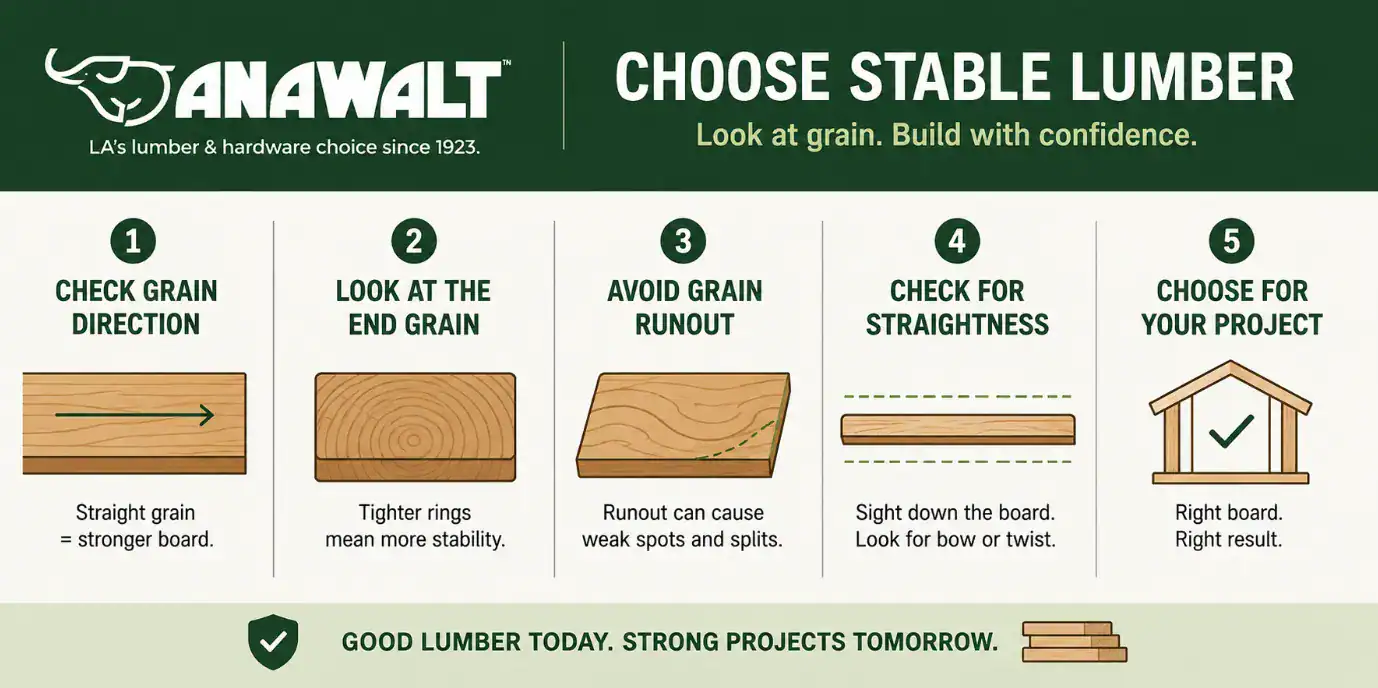
Pick up the board and look down its length.
I usually think of it like looking down a long hallway. You are trying to see whether the edges stay in a fairly straight line.
Look for bowing.
Then turn the board and check again.
Look for twisting too. A twisted board may have corners that seem to rotate away from each other along its length.
Also check for crook, where the board curves sideways.
A tiny amount of movement may not matter for your project. A badly twisted board can be another story.
If you are building a rough outdoor structure, you may tolerate something you would never accept for a cabinet face.
That is why knowing how to inspect lumber really depends on what you plan to do with it.
Grain Runout Deserves a Closer Look
Grain does not always travel neatly from one end of a board to the other.
Sometimes the fibers angle toward the edge and run out of the board.
This is grain runout.
You can often spot it by following the visible grain lines. If they keep traveling toward an edge instead of staying along the length, the grain may be running out.
Why does that matter?
Because wood grain direction affects how force travels through the fibers.
In some projects, grain runout can create an area that is more likely to split or break under stress.
It can also make planing and other woodworking operations a little trickier. Cutting against changing grain may cause tear-out, where pieces of wood lift or break instead of cutting cleanly.
For basic construction, a little grain runout may not be a big concern.
For a chair leg, long shelf, handle, or another part where strength matters, you may want to be more selective.
Think About What the Board Will Become
Lumber selection for woodworking becomes much easier when you know the job of each piece.
Suppose you are building a table.
The boards used for the top need to work together across a wide surface. Appearance matters, but movement matters too.
A table leg has another job. Strength and straight grain may be more important there.
Trim has different needs.
Framing lumber has different needs again.
So instead of asking, “Is this a good board?” try asking, “Is this a good board for this part of my project?”
That small change in thinking helps.
Wood grain direction is one part of the answer, along with species, moisture, dimensions, knots, defects, and how the lumber will be used.
Do Not Judge a Board Only by Pretty Grain
Interesting grain patterns can be beautiful.
Sometimes that is exactly what you want.
But dramatic grain does not automatically mean the board is more stable.
In fact, unusual grain around knots, branches, or changing growth patterns can sometimes make the board behave less predictably.
That does not mean you should avoid it.
Maybe you are making a decorative panel where appearance matters more than structural strength. In that case, an unusual grain pattern might be the reason you choose that board.
For a long structural piece, perhaps not.
Learning wood grain direction is partly about learning that appearance and performance are connected, but they are not exactly the same thing.
A plain-looking board can sometimes be the better choice.
Let Lumber Adjust Before Building
Even a carefully selected board can move after you bring it home.
The lumber may have been stored in conditions that are different from the place where your project will live.
Giving wood some time to adjust to its new environment can help, especially for indoor furniture, cabinets, and finish work.
How long it needs depends on the lumber, its moisture level, dimensions, and the environment.
There is no magic number that works for every piece.
It also helps to store boards properly while they are waiting. Keeping them supported and reasonably flat can reduce the chance of creating new bends or twists.
This is one of those steps that feels like nothing is happening.
You are just waiting.
But sometimes waiting is part of woodworking.
A Quick Lumber Check Before You Buy
You do not need a complicated system when standing at the lumber rack.
Start with the board’s overall shape.
Sight down the length and check for bow, twist, and crook. Look across the face for cupping.
Then study the grain.
Follow the wood grain direction along the board and notice whether it stays fairly straight or runs sharply toward an edge.
Check knots, splits, checks, and other visible defects.
Look at the end grain and see how the growth rings are oriented.
For projects where appearance matters, turn the board over too. Sometimes the other face looks completely different.
And think about where you are going to cut it.
A defect near one end may not matter if that section will be removed anyway.
You do not always need a flawless board. You need enough good lumber for the pieces your project requires.
Choosing Stable Lumber Gets Easier With Practice
At first, a stack of lumber can look like a stack of nearly identical boards.
After a while, you start noticing differences.
One is straighter.
Another has cleaner grain.
One has a knot exactly where you do not want it. Another has beautiful grain but a slight twist.
You begin making little tradeoffs.
That is normal.
Anawalt Lumber can help customers compare lumber options based on the type of project, the wood species, dimensions, and the characteristics of individual boards.
When learning how to choose stable lumber, remember that stability is not about finding wood that never changes. Natural wood will react to moisture and its environment.
Instead, look for boards that start in good condition and have grain suited to the job.
Understanding wood grain direction gives you another useful clue. Look at the face. Check the edges. Take a quick look at the growth rings on the end.
Then sight down the entire board before putting it on your cart.
It takes a little extra time, maybe only a minute.
But when the board becomes part of a table, shelf, wall, cabinet, or another project you plan to keep for years, that minute can be worth it.