
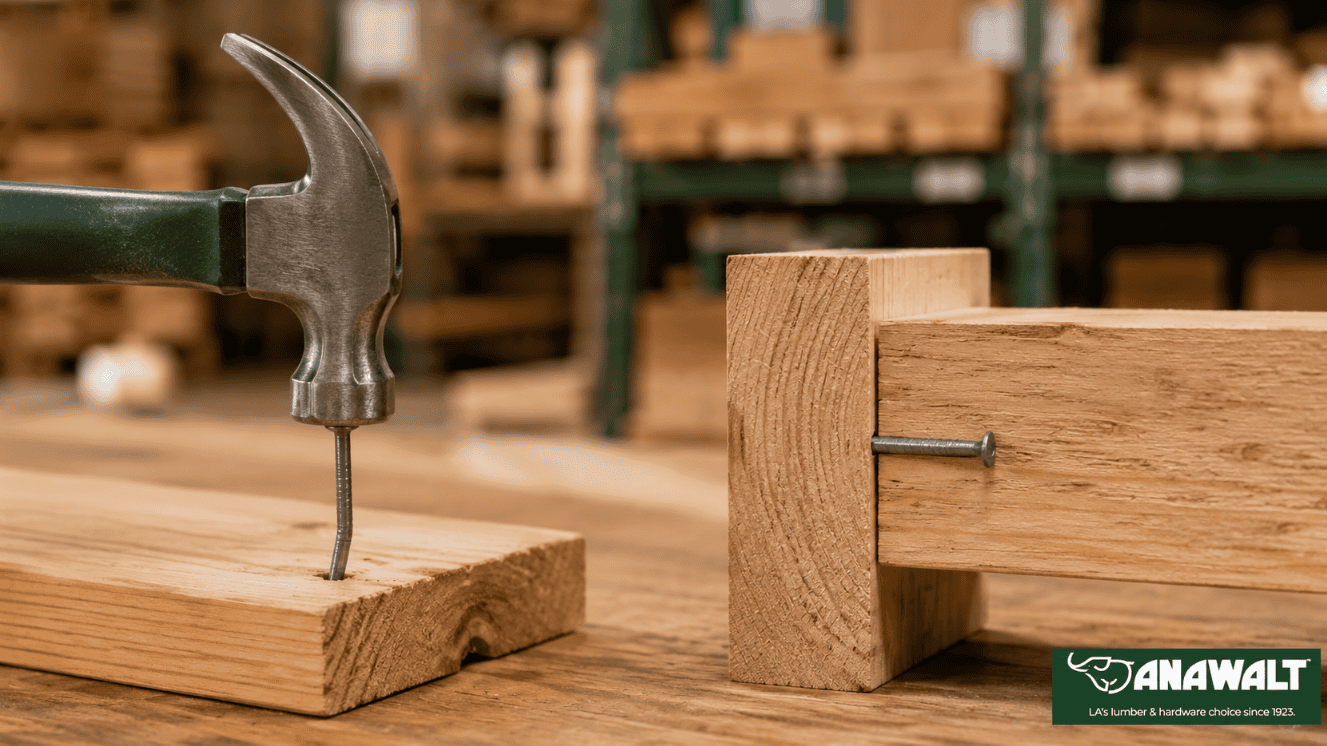
A nail may look like a very simple piece of hardware. It is straight, small, and easy to overlook. Still, a nail can handle force in more than one direction, and that direction changes how the connection performs.
One force tries to pull the nail straight out of the wood. Another pushes the nail sideways. These forces test different parts of the fastener and the wood around it.
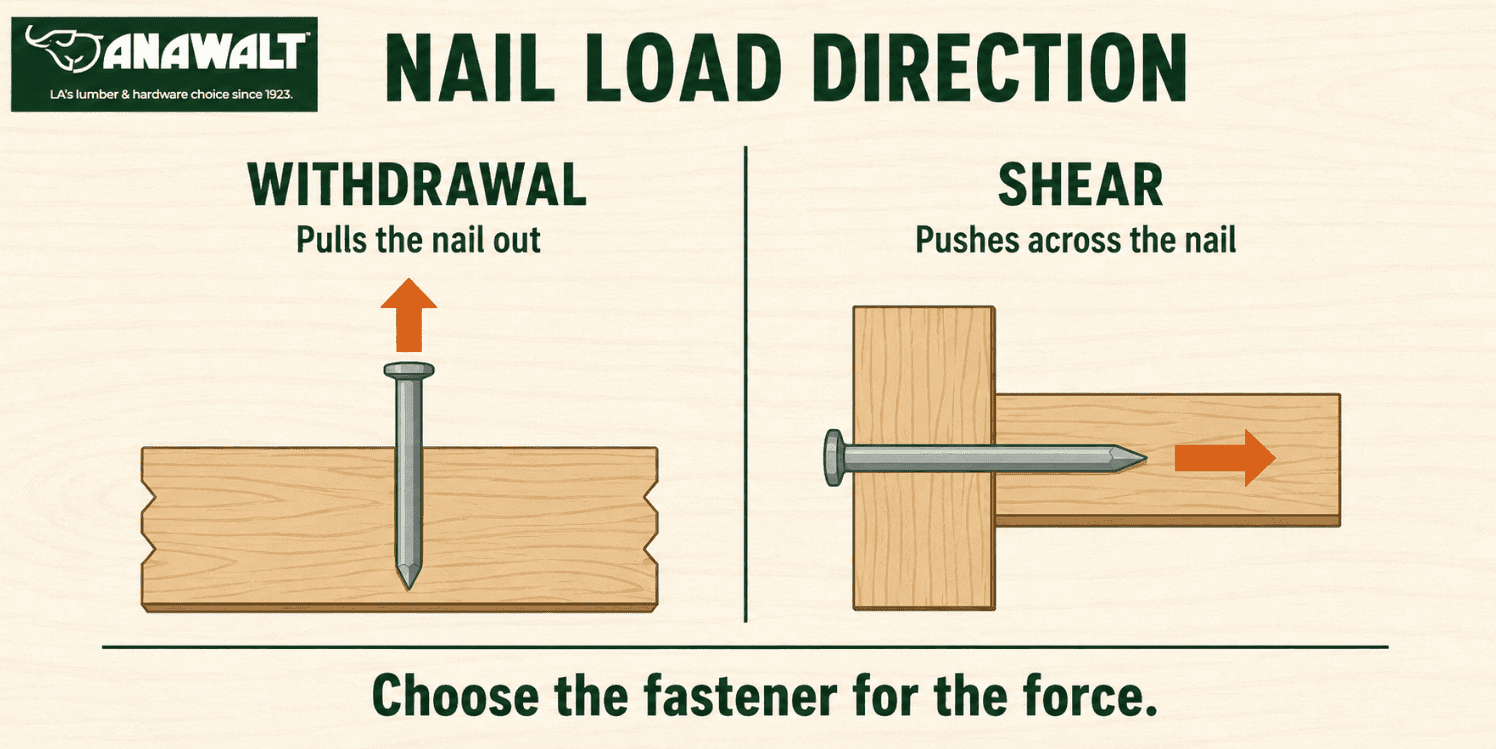
This is where nail withdrawal strength becomes important. It describes how well a nail resists being pulled out along the direction of its shaft. Shear strength is different. It describes how well the nail handles force moving across its shaft.
At Anawalt Lumber, we think understanding this difference can help people choose fasteners more carefully. It may also prevent loose boards, weak joints, and repairs that show up sooner than expected.
The nail matters. The wood matters too. But the direction of the load might matter even more.
Contact Us

Key Takeaways
- Withdrawal force tries to pull a nail straight out of the wood.
- A shear load pushes across the nail instead of pulling along it.
- Nail withdrawal strength depends on the shank, penetration depth, wood species, grain direction, and moisture.
- Nail shear strength is affected by nail diameter, steel properties, wood thickness, and the design of the connection.
- Ring-shank nails usually provide more pullout resistance than smooth-shank nails.
- Nails driven into end grain may have less reliable holding power.
- A nail that performs well under one load direction may not be the right choice for another.
- Building plans and connector instructions should guide structural fastener selection.
What Is Nail Withdrawal Strength?
Nail withdrawal strength is the ability of a nail to resist a force that tries to pull it straight out of the wood.
Picture a fence board attached to a rail. If the board tries to move directly away from the rail, the nails are placed under a withdrawal load. The wood fibers gripping the nail must keep it from sliding out.
Several things affect that grip:
- Nail shank design
- Nail diameter
- Penetration into the supporting wood
- Wood density
- Moisture level
- Grain direction
- Age and condition of the wood
- Repeated movement
A smooth nail depends mostly on friction between its shank and the wood fibers. A ring-shank nail has raised rings that engage the wood more aggressively.
That sounds like a small difference. In practice, it can be quite important.
What Is Nail Shear Strength?
Nail shear strength describes how well a nail resists force moving sideways across its body.
Imagine two boards connected face to face. One board tries to slide down while the other stays in place. The nail is not being pulled straight out. Instead, the boards push sideways against it.
That creates a shear load on nails.
The nail may bend slightly as it transfers the load from one board to another. The wood surrounding the nail also experiences pressure. So, nail shear strength is not only about whether the metal snaps. The complete connection matters.
Factors can include:
- Nail diameter
- Nail material
- Thickness of the connected boards
- Number of nails
- Nail spacing
- Distance from board edges
- Wood density
- Direction of the grain
- Whether the load is steady or repeated
Thicker nails often handle greater sideways force, but bigger is not automatically better. A large nail placed too close to an edge might split the wood.
Contact Us
What Is the Difference Between Withdrawal and Shear Loads?
The easiest way to understand nail withdrawal vs shear strength is to look at the direction of movement.
A withdrawal load acts along the nail’s shaft. It tries to pull the nail out.
A shear load acts across the shaft. It tries to slide the connected materials past one another.
Here is a simple comparison:
- A loose fence picket moving away from a rail creates withdrawal force.
- Wall sheathing resisting sideways building movement can place nails under lateral loads.
- A board hanging from another board may place sideways force on its fasteners.
- Decking that lifts as it dries can create withdrawal force.
- A connection can experience both forces at the same time.
That last point is easy to miss. Loads do not always stay neat and separate. Wind, people walking, wood movement, and vibration can pull and push a connection in several directions.
Why Does Nail Load Direction Matter?
Nail load direction matters because fasteners do not have equal strength in every situation.
A nail might resist a sideways load well but slowly loosen when it is repeatedly pulled outward. Another nail may have excellent pullout resistance but still be unsuitable for a structural connector.
This is why nail holding power cannot be described with one simple number.
The connection must be evaluated based on the force it is expected to carry. A roof, fence, cabinet, deck, and wall may all use nails, but the loads are not the same.
It is a bit like choosing shoes. A sturdy pair for walking may not be right for climbing. Both are shoes, yes, but the job changes what you need.
What Factors Affect Nail Withdrawal Resistance?
Several factors affecting nail strength also influence nail withdrawal strength.
Nail shank design
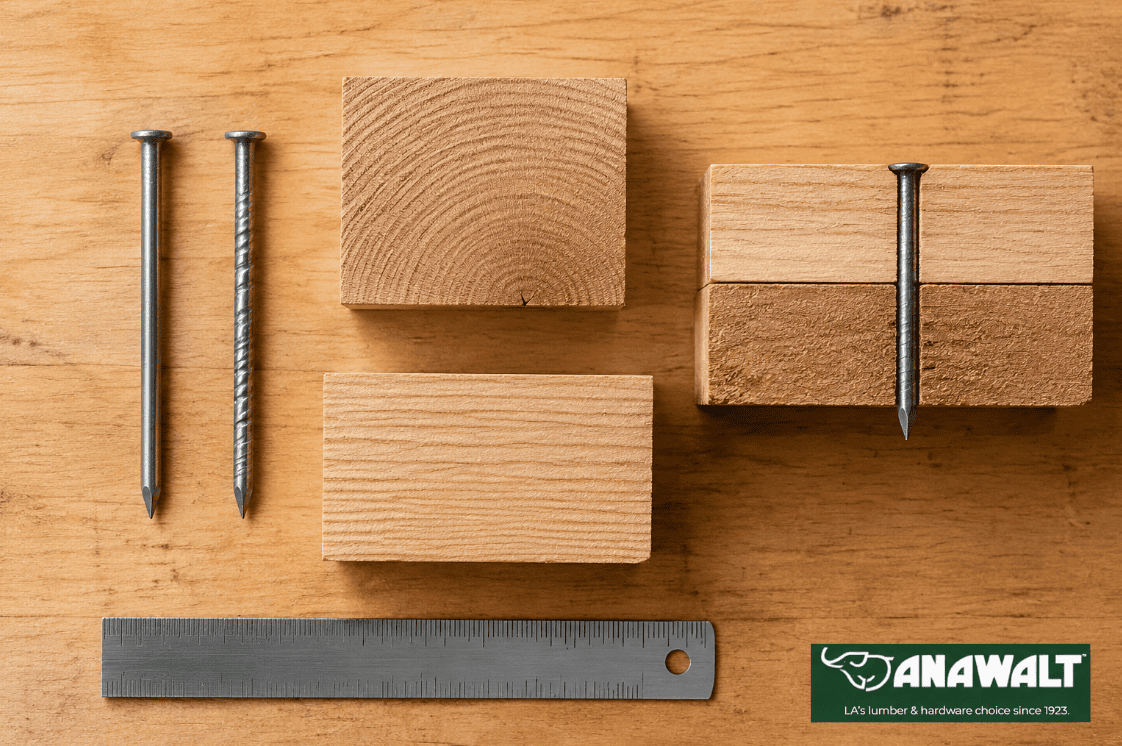
Smooth-shank nails are easy to drive and common in general construction. Ring-shank and screw-shank nails have textured surfaces that create greater resistance to pullout.
When comparing ring-shank vs smooth-shank nails, ring-shank nails are often selected for jobs where boards might lift or move. Subfloors, sheathing, siding, and decking are common examples, depending on the plans and materials.
Nail penetration depth
Nail penetration depth affects how much of the shank is gripped by the supporting wood.
A nail that barely enters the main framing member has less wood holding it. A longer nail may provide more engagement, though excessive length does not fix poor placement or the wrong nail type.
The important measurement is usually penetration into the receiving member, not just total nail length.
Wood density
Dense wood can provide strong nail pullout resistance because the fibers press firmly around the shank.
Very dense wood can also split if the nail is too large or placed near an edge. Predrilling might be needed in some hardwood applications.
Softer wood is easier to nail. It may not grip a smooth shank as strongly, however.
Moisture and wood movement
Wet lumber may grip a nail differently as it dries. The wood can shrink around the connection, and repeated moisture changes may slowly loosen the fastener.
Outdoor connections deal with this problem more often. Rain, dry weather, heat, and seasonal changes keep the wood moving.
Grain direction
Wood fastener load direction and wood grain direction work together.
Nails driven across the grain generally receive support from many wood fibers. Nails driven into end grain run more parallel with those fibers.
End-grain nail holding power is usually less dependable for withdrawal loads. The fibers can separate more easily, almost like pushing a nail into the end of a bundle of drinking straws.
For important connections, do not assume an end-grain nail will provide the same resistance as one driven into side grain.
Contact Us
How Do Nail Diameter and Strength Work Together?
Nail diameter and strength are connected, but there are tradeoffs.
A thicker nail generally has more metal available to resist bending and shear. It also creates a larger bearing area against the wood.
Still, a thicker nail displaces more wood when driven. That can increase splitting risk, particularly near the end or edge of a board.
A smaller nail may reduce splitting but provide less lateral nail strength.
This is why structural fastening schedules specify more than nail length. They may identify the nail diameter, quantity, spacing, and placement.
A nail labeled only by length does not provide the whole story.
Do Ring-Shank Nails Have Better Pullout Strength?
Ring-shank nails generally offer greater nail pullout strength than comparable smooth-shank nails.
The rings create mechanical resistance inside the wood. Instead of relying only on smooth friction, the shank has ridges that make it harder for the nail to slide backward.
These nails are commonly considered when materials may experience:
- Lifting
- Vibration
- Moisture changes
- Repeated movement
- Seasonal swelling and shrinking
That does not mean ring-shank nails are best for every connection. Some structural connectors require a particular approved nail. Substituting a different nail because it appears stronger can change how the connector performs.
Follow the connector manufacturer’s instructions. Honestly, this is one area where guessing is not worth it.
Are Nails Stronger Than Screws Under Shear Loads?
People often say nails are better for shear while screws are better for pullout. That statement can be useful, but it is too broad to serve as a rule.
Common framing nails can bend and deform under sideways force. Some ordinary screws are harder and more brittle, so they might snap instead of bending.
Structural screws are a different category. They are designed, tested, and rated for specific loads. They should not be grouped with drywall screws or general-purpose screws.
When comparing fastener shear strength, look at the exact product rather than assuming every nail or screw performs the same way.
For a structural project, use the fastener listed in the building plan, fastening schedule, or connector instructions.
Can One Nail Experience Shear and Withdrawal Together?
Yes. Many real connections experience combined loads.
Wind might pull siding away from a wall while also moving it sideways. A deck board can lift and shift as people walk across it. A fence can bend under wind, creating both outward and lateral force.
This is why the difference between nail withdrawal strength and shear capacity should not be treated as a perfect either-or choice.
The connection may need to resist:
- Straight pullout
- Sideways sliding
- Bending
- Vibration
- Repeated loading
- Moisture-related movement
Sometimes the load changes direction during the life of the project. Wood moves, weather changes, and people use structures in ways that were not obvious at first.
How Can You Improve Nail Holding Power?
The correct solution depends on the project, but several basic practices help:
- Use the nail type specified for the job.
- Provide enough penetration into the receiving wood.
- Keep nails away from board ends and edges.
- Use the correct nail spacing.
- Avoid overdriving nail heads.
- Choose corrosion-resistant fasteners for exterior work.
- Match fasteners with pressure-treated lumber requirements.
- Replace split or badly damaged wood.
- Follow structural connector instructions.
- Do not substitute drywall screws for structural nails.
Adding more nails is not always the answer. Nails placed too close together can split the wood or weaken the area around the connection.
Placement matters just as much as quantity. Perhaps more, in some cases.
Frequently Asked Questions
What is a withdrawal load on a nail?
A withdrawal load pulls along the length of the nail and attempts to remove it from the wood.
What is a shear load on a nail?
A shear load acts sideways across the nail. It tries to slide the connected pieces past each other.
Do longer nails have better pullout resistance?
Longer nails may provide more resistance when the extra length increases penetration into sound supporting wood. Total length alone does not guarantee a stronger connection.
Are ring-shank nails stronger than smooth nails?
Ring-shank nails typically provide better withdrawal resistance. Shear performance also depends on nail diameter, material, wood condition, and connection design.
Can nails driven into end grain hold structural loads?
End-grain fastening usually provides less reliable withdrawal resistance. Structural applications should follow approved plans, building requirements, or engineered connection details.
Does a thicker nail always create a stronger connection?
Not always. A thicker nail may improve shear capacity, but it can also split wood when placed too close to an edge or board end.
Can I replace connector nails with deck screws?
Not unless the connector manufacturer specifically approves that screw. Connector ratings depend on the listed fastener type, size, and installation pattern.
Why do nails slowly work out of wood?
Moisture changes, vibration, repeated movement, insufficient penetration, smooth shanks, or damaged wood can reduce nail pullout resistance over time.
Choose the Fastener for the Load
A nail does more than hold two pieces of wood together. It transfers force between them.
Before selecting one, ask how the connection is likely to move. Will the material try to pull away? Will it slide sideways? Could it experience both?
Understanding nail withdrawal strength helps explain why some nails loosen while others remain secure. Understanding shear strength explains why diameter, spacing, and nail material matter when loads move across a connection.
At Anawalt Lumber, customers can compare nail types, structural fasteners, and compatible hardware for different projects. For structural work, always follow the approved plans, local requirements, and manufacturer instructions.
The nail may be small. Its direction of load is not a small detail.
Contact Us