

Joist hangers don’t look like much. They’re small pieces of bent galvanized steel with a lot of nail holes. But they hold up decks and floors, and when one is the wrong size or has the wrong fasteners in it, the connection can be a lot weaker than it looks. We sell structural connectors every day, and these are the things we wish more people knew before they bought them.
Key Takeaways
- Without a hanger, the joist would be held by nails driven in at an angle, which isn’t very strong.
- There are dozens, but most jobs use one of a handful.
- Go by the joist’s real dimensions, not its name.
- Hangers are tested with particular fasteners, and the rated load assumes you use them.
What Does a Joist Hanger Do?
It holds the end of a joist where it meets a beam, a ledger board or a header. Without a hanger, the joist would be held by nails driven in at an angle, which isn’t very strong. The hanger cradles the joist from underneath and spreads the load through a lot of fasteners at once, so the connection is stronger and more predictable.
Building codes often require hangers for certain connections, especially on decks. Inspectors pay close attention to them, since a failed ledger or joist connection can cause real harm. If you’re not sure what your project needs, the plans and your local code come first.
What Types Are There?
There are dozens, but most jobs use one of a handful.
| Type | How it attaches | Typical use |
|---|---|---|
| Face-mount | Nailed into the face of the beam or ledger | Decks and floors with joists flush to the beam top |
| Top-flange | Hooks over the top of the beam | Headers where face nailing is limited |
| Skewed | Angled seat | Joists meeting a beam at an angle |
| Concealed flange | Flanges tucked inside | Ends of beams, or where looks matter |
| Double or engineered | Wider seat | Doubled joists, LVLs and I-joists |
Simpson Strong-Tie is the best-known maker of these, and we stock their connectors. Their model names help with sizing. In the LUS28, for example, the 28 means it’s built for a 2×8.
How Do You Pick the Right Size?
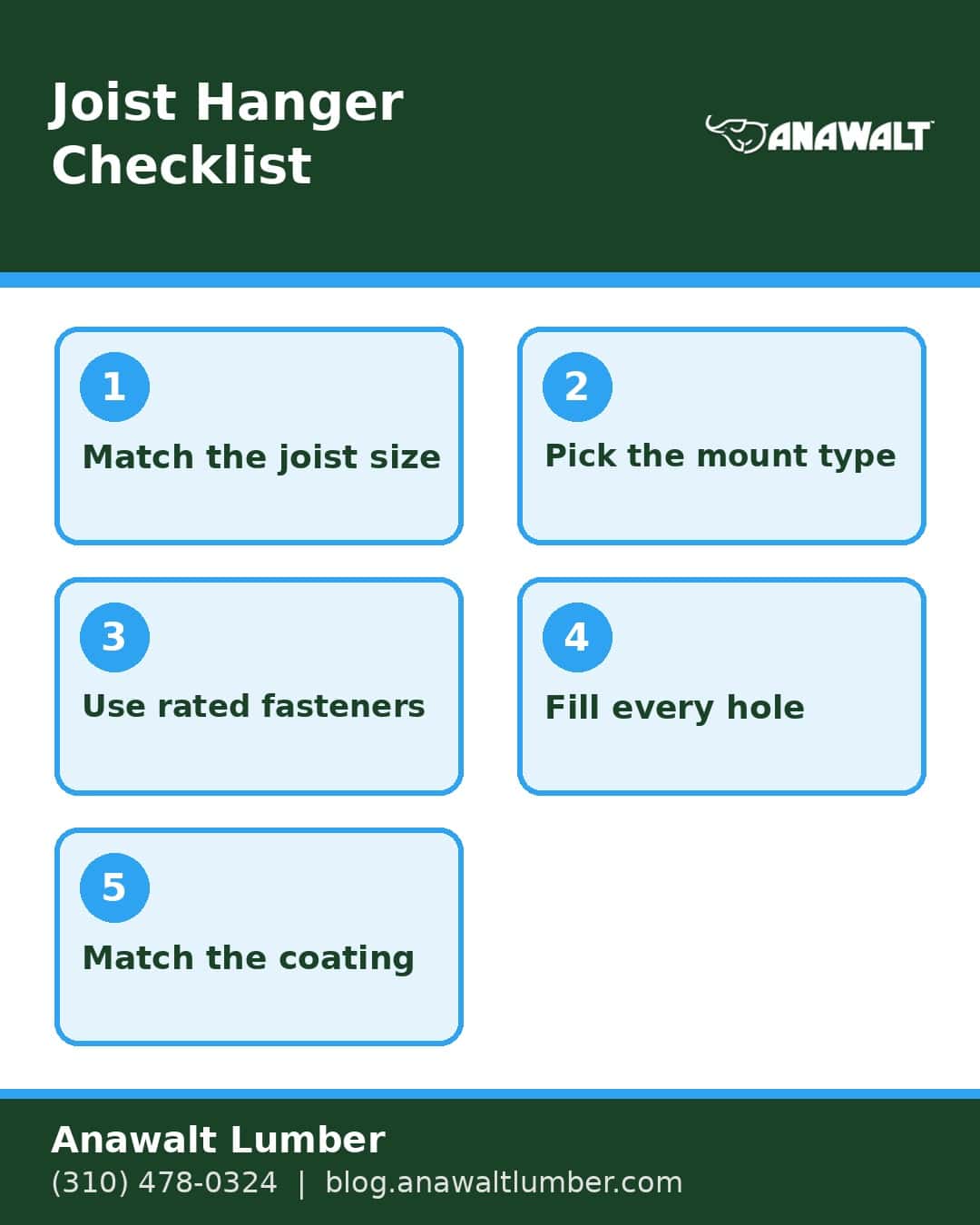
Go by the joist’s real dimensions, not its name. A 2×8 is actually about 1-1/2 inches wide and 7-1/4 inches deep, and a doubled 2×8 is about 3 inches wide. LVLs and I-joists have their own sizes, so check the label or measure.
The hanger should be the same width as the joist and cover most of its depth. Too short and it won’t carry the full load. Too wide, and the joist can shift around inside it. If nominal versus actual sizes are confusing, our guide on choosing the right lumber for your project explains them.
Which Nails or Screws Should Go in It?
This is where we see the most mistakes. Hangers are tested with particular fasteners, and the rated load assumes you use them. For a face-mount hanger like the LUS28, Simpson lists 0.148 by 3-inch nails or its own Strong-Drive SD connector screws in specific sizes.
What doesn’t belong in a hanger is a drywall screw or a regular deck screw. They’re either too brittle or not strong enough in shear for this kind of load. Every hole the manufacturer calls for should be filled, because each empty one lowers the rated strength. The fasteners should also have the same corrosion protection as the hanger itself. Our article on nail withdrawal vs. shear strength explains why fastener choice matters so much here.

What About Treated Lumber and Rust?
Pressure-treated lumber has chemicals in it that corrode standard galvanized steel faster than untreated wood does. For decks and outdoor framing, a lot of builders use hangers with a heavier zinc coating, which Simpson sells under the name ZMAX, or they go with stainless steel. Close to the ocean, stainless is often the better pick, since salt air speeds up rust.
Don’t mix metals. Putting stainless fasteners in a galvanized hanger, or the other way around, can make one of them corrode faster. Our guide to stainless vs. galvanized fasteners covers coastal projects in Malibu and nearby areas in more detail.
How Should They Be Installed?
Mark the joist layout on the beam or ledger first. Set each hanger so the joist sits tight against the seat without a gap underneath, and usually so the top of the joist ends up flush with the top of the beam. Most people nail the hanger to the beam first, then drop the joist in and nail through the side holes. Some hangers use angled nails that go through the joist into the beam, and those add strength when they’re driven at the right angle.
Never bend or cut a hanger to make it fit. That changes how it carries load.
What Goes Wrong Most Often?
Wrong fasteners, empty holes, and hangers that don’t match the joist are the big three. Using an indoor hanger outside is another, because it’ll rust over time. Reading the label and following the instructions avoids most of these, and our staff is happy to help match parts to your plans.
Get Joist Hangers and Lumber in One Stop
We at Anawalt Lumber stock joist hangers, connectors, fasteners, and framing lumber at our Los Angeles area stores, and we can help you match parts to your plans. Browse our hardware and building materials, or call our West LA store at (310) 478-0324. Family-owned since 1923, we also offer delivery for larger orders.
Frequently Asked Questions
Q: Can I use screws in joist hangers?
A: Only screws the hanger maker lists for that hanger, such as Simpson’s SD connector screws. Regular deck and drywall screws aren’t rated for these loads.
Q: Do I need to fill every nail hole?
A: Fill every hole the manufacturer calls for. Empty holes reduce the rated strength of the connection.
Q: What joist hangers should I use with treated lumber?
A: Hangers with a heavy zinc coating, like ZMAX, or stainless steel, with fasteners that match.
Q: What’s the difference between face-mount and top-flange hangers?
A: Face-mount hangers nail into the side of the beam, while top-flange hangers hook over the top.
Q: Do joist hangers need to match the joist size exactly?
A: They should match the width and cover most of the depth. A poor fit weakens the connection.